

2026 Chevrolet Silverado 1500 Towing Capacity | Yoder Chevrolet — Fort Lupton, CO
2026 Silverado 1500 Towing Capacity: Up to 13,300 lbs — What You Need to Know
By Ryan Green, Marketing Director
Yoder Chevrolet | Fort Lupton, CO | March 6, 2026
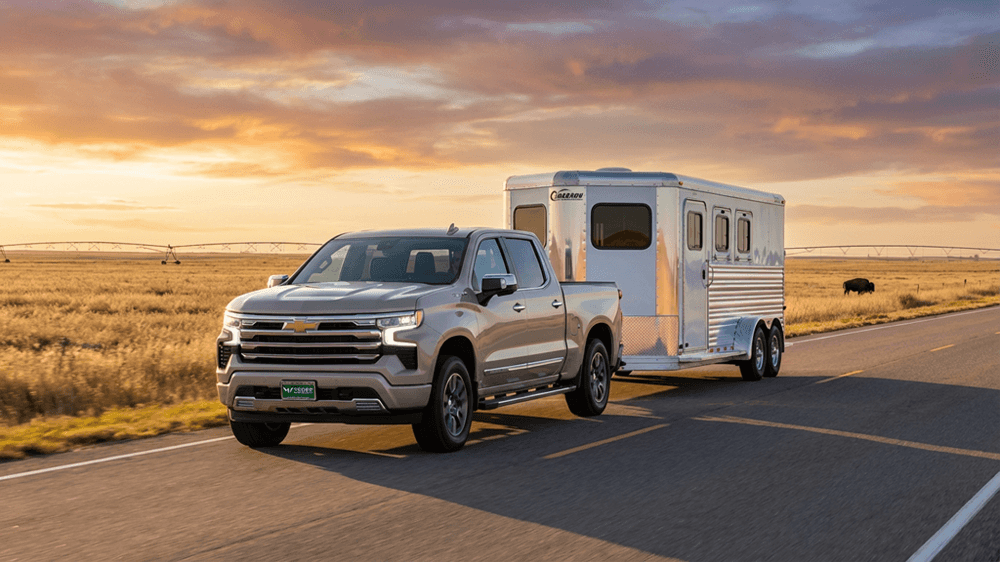
The 2026 Chevrolet Silverado 1500 delivers impressive towing capacity that handles everything from horse trailers and boats to fifth-wheel RVs and livestock haulers. But reaching that headline 13,300 lbs number requires understanding exactly which configuration gets you there. In this guide, we’ll break down towing capacity by engine, explain advanced trailering technology, and show you how Colorado’s mountains present unique towing challenges and opportunities.
How Does the Silverado Reach 13,300 lbs?
The 13,300 lbs maximum towing capacity isn’t available on every Silverado 1500 configuration. It’s the result of combining specific components that work together to handle maximum loads safely. Here’s what you need:
- 6.2L EcoTec3 V8 Engine — Only the largest gasoline V8 achieves this number. The 5.3L reaches 11,300 lbs, and the 2.7L TurboMax handles 9,500 lbs.
- Max Trailering Package — This factory package includes an upgraded rear axle ratio (higher numerical ratio for better towing torque), enhanced cooling systems for the transmission and engine, integrated trailer brake controller, and reinforced rear springs.
- Crew Cab Configuration — The full four-door cab provides better weight distribution compared to Regular Cab or Double Cab models, allowing the truck to carry heavier loads.
- 4WD Drivetrain — Four-wheel drive is required for the maximum rating. Two-wheel drive versions have slightly lower capacities.
The good news: most buyers don’t need 13,300 lbs. The 5.3L V8 with 11,300 lbs handles the vast majority of real-world towing scenarios — horse trailers, mid-size RVs, boats, and equipment trailers.
Towing Capacity by Engine
Each engine in the 2026 Silverado 1500 lineup offers different towing and payload capabilities. Here’s how they compare:
| Engine | Max Towing | Max Payload | Best For |
|---|---|---|---|
| 2.7L TurboMax | 9,500 lbs | 2,260 lbs | Budget buyers, light towing, payload haulers |
| 5.3L EcoTec3 V8 | 11,300 lbs | 1,940 lbs | Most buyers, horses, boats, small RVs |
| 6.2L EcoTec3 V8 | 13,300 lbs (w/ Max Package) | 1,660 lbs | Maximum towing, fifth-wheels, horse trailers |
| 3.0L Duramax Diesel | Competitive | Competitive | Long-haul towing, fuel economy (28 hwy MPG) |
About Payload Capacity
Notice that the 2.7L TurboMax has the highest payload (2,260 lbs) but the lowest towing capacity. This is because payload is weight in the truck bed and cab, while towing is weight behind the truck. If you need to carry tools and equipment in the bed while towing, the 2.7L is your best choice.
Advanced Trailering Technology
The 2026 Silverado 1500 includes industry-leading trailering features that make towing safer, easier, and more confident — especially important when navigating Colorado’s demanding terrain.
Up to 14 Camera Views
Including a transparent trailer view that shows what’s directly behind your trailer, making hitching and backing up much easier and safer.
Trailer Profiles & Brake Controller
Store multiple trailer profiles with different configurations. The integrated trailer brake controller adjusts trailer braking independently during descents.
Tire Pressure & Temperature Monitoring
Real-time monitoring of trailer tire pressure and temperature helps prevent blowouts, especially critical at altitude or during long Colorado hauls.
Trailer Sway Control
Automatically detects and reduces trailer sway by applying trailer brakes and adjusting engine power — essential in Colorado’s windy mountain passes.
Auto Grade Braking
Automatically downshifts to the appropriate gear to maintain a consistent speed on steep descents without relying on brake wear. Critical for mountain passes like Vail.
Trailer Side Blind Zone Alert
Alerts you if vehicles are in your trailer’s blind spots, helping prevent dangerous lane changes while towing.
Towing in Colorado — What You Need to Know
Colorado towing presents unique challenges that buyers from other states should understand. Fort Lupton sits at 4,900 feet elevation, but major mountain passes push 11,000+ feet. These conditions require specific knowledge.
Mountain Grades and Elevation
When towing in Colorado mountains, you’ll encounter steep grades that test your truck’s cooling and braking systems:
- Vail Pass (US-6 to I-70): 6% grade sustained for several miles. This is where many trucks start to struggle with brake fade if they don’t have an advanced trailer brake system.
- Eisenhower & Johnson Tunnels: Elevation reaches 11,013 ft with steep approaches on both sides. The westbound grade peaks at 7% in places. Altitude here reduces engine power by about 20-25% compared to sea level.
- Vail to Salida via US-285: Even steeper grades if you’re heading to south-central Colorado. Popular route for horse trailers and RVs headed to ranches and campgrounds.
How Engines Perform at Altitude
All 2026 Silverado engines are engineered for altitude performance:
- 2.7L TurboMax & 6.2L V8: Turbocharged/supercharged engines use forced induction to maintain power in thin air. They handle altitude better than naturally aspirated engines because they’re “pushing” air into the cylinders.
- 5.3L EcoTec3 V8: Naturally aspirated but still very capable at altitude. You’ll feel some power loss, but 11,300 lbs towing remains achievable on mountain grades.
- 3.0L Duramax Diesel: Diesel engines maintain consistent torque regardless of altitude — a major advantage for Colorado towing. Plus, 28 hwy MPG fuel economy means fewer expensive stops on I-70.
Eastern Plains Towing
The eastern plains (Weld County, Logan County, and beyond) offer flat terrain where towing is less demanding. Cattle trailers, livestock haulers, and equipment trailers regularly tow on open highways without the thermal stress of mountain descents. Your Silverado 1500 will perform closer to its maximum capacity on flat terrain, though elevation still affects turbo engines slightly.
Payload vs. Towing Capacity Explained
Many buyers confuse these two critical numbers. Here’s the difference and why it matters:
Towing Capacity
The maximum weight your truck can pull behind it (the trailer and its contents). A 5,000 lb horse trailer is towing capacity. So is a 12,000 lb fifth-wheel RV.
Payload Capacity
The maximum weight you can carry in the bed and cabin of the truck. This includes passengers, tools, equipment, and cargo loaded directly into the Silverado itself — not the trailer.
Why Both Matter
Imagine a contractor who needs to tow a 6,000 lb equipment trailer AND haul 1,500 lbs of tools in the bed. The 5.3L V8 can tow 11,300 lbs (excellent for the trailer), but its payload is only 1,940 lbs. You’d exceed payload capacity. The 2.7L TurboMax with 2,260 lbs payload could handle this scenario better, though it maxes out at 9,500 lbs towing.
Common Towing Scenarios in Weld County & Beyond
Here are real-world towing situations you might encounter in northern Colorado and what engine you’d need:
| Scenario | Typical Weight | Recommended Engine |
|---|---|---|
| 2-Horse Trailer | 4,000–6,000 lbs | 2.7L TurboMax or higher |
| 4-Horse Gooseneck (Loaded) | 8,000–12,000 lbs | 5.3L V8 or 6.2L V8 |
| Bass Boat or Center Console | 4,000–6,000 lbs | 2.7L TurboMax or higher |
| 20-ft Enclosed Cargo Trailer | 5,000–8,000 lbs | 2.7L TurboMax or higher |
| Mid-Size Travel Trailer (24-ft) | 4,000–6,000 lbs | 2.7L TurboMax or higher |
| Full-Size Travel Trailer (28-32 ft) | 6,000–10,000 lbs | 5.3L V8 preferred |
| Fifth-Wheel RV (30-35 ft) | 10,000–15,000 lbs | 6.2L V8 w/ Max Package |
| Equipment Trailer (20 ft flatbed) | 3,000–5,000 lbs empty | 2.7L TurboMax or higher |
| Cattle Trailer (double-deck, loaded) | 8,000–10,000 lbs | 5.3L V8 or higher |
0 comment(s) so far on 2026 Chevrolet Silverado 1500 Towing Capacity | Yoder Chevrolet — Fort Lupton, CO